
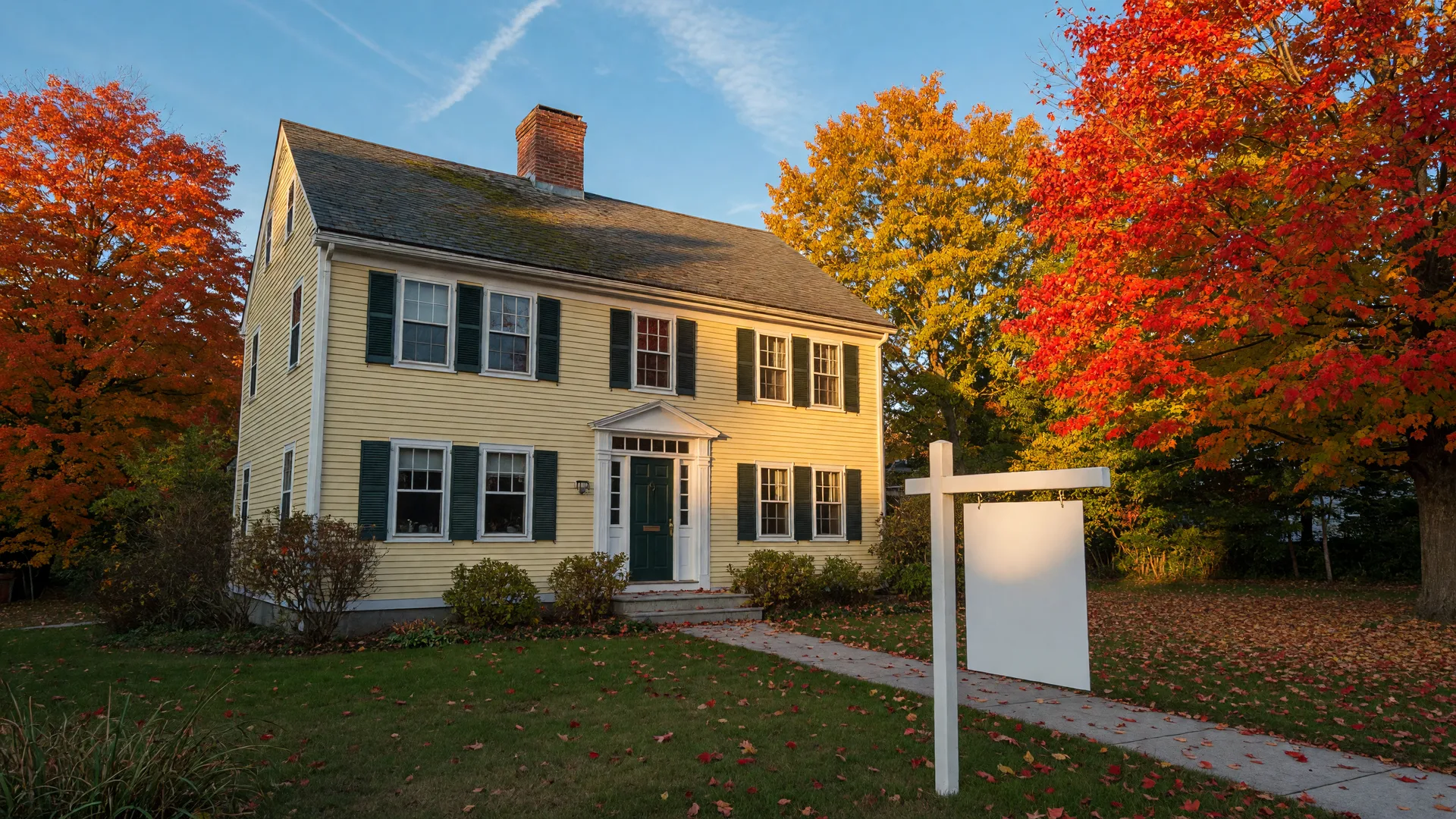
Short answer: yes, for most Central Massachusetts homeowners, fall is a genuinely good time to sell, often better than people expect. September and October have become the state’s second peak season after spring, and with 30-year mortgage rates near 6.8% the buyers who are out there this time of year tend to be serious and ready to move. The catch is pricing: this fall’s market has more inventory than we have seen in years, so homes that sell quickly are almost always priced against current comparable sales, not last spring’s peak or last year’s numbers.
Is fall a good time to sell a house in Massachusetts?
Yes, for most sellers, with one important condition. September and October are now Massachusetts’ strongest secondary selling season, and fall buyers are typically motivated: they want to close before the holidays, the snow, and the year-end lull. In 2026 the condition is pricing, because inventory is visibly higher than a year ago in both Worcester County and Middlesex County. The homes selling fastest this fall will be priced against what comparable homes actually closed for in the last 60 to 90 days, not against last year’s peak. I break down the data and the checklist below.
Why fall has become a second selling season
This is not a seasonal cliché; it is now documented market behavior. Just last week, on September 17, 2026, The Boston Globe wrote that Greater Boston has shifted to a two-season market, spring and fall, with fall now one of real estate’s genuine high seasons. Massachusetts Association of Realtors data cited in that piece showed Greater Boston median single-family sale prices of $880,000 in September 2025 and $905,000 in October 2025, holding well above the year’s seasonal low.
The buyers behind those sales are different from summer browsers. People who shop in September and October are often relocating for work, moving up with a school-year deadline in sight, or downsizing before winter, and they tend to be pre-approved and ready to act. Analyses like Houzeo’s Massachusetts timing guide estimate roughly 20% to 30% fewer competing buyers in the fall-to-winter window, which means your home gets more attention per showing. That is an estimate from an industry source, not a guarantee, but it matches what I am seeing in Worcester County right now: fewer showings than in May, and a higher share of them turning into real offers.
What the 2026 data says for our counties right now
I publish a weekly market update, so here is the verified snapshot for the two counties I serve, current as of mid-September 2026:
Worcester County: active listings are running near 2,709, up about 11.5% from a year ago, with about 2.4 months of supply and a median of 21 days on market. The most complete closed-sale reading, June deed data published September 14, put the county median near $505,000, while Redfin’s more current August estimate was about $508,000, up 2.7% year over year. The story is a plateau, not a slide: prices are holding steady while buyers gain choices.
Middlesex County: the August median came in near $847,000, up 2.1% year over year, with homes selling in a median of about 23 days and 46% of sales closing above list price. Inventory hit 4,327 active listings, up 20.2% year over year, and new listings jumped about 29% versus August 2025. Supply is still tight at roughly 1.75 months, so well-priced homes continue to attract real competition.
Add mortgage rates: the 30-year fixed averaged 6.76% nationally in the Freddie Mac Primary Mortgage Market Survey for the week ending September 10, 2026, up from 6.35% a year earlier. Higher rates have pushed some marginal buyers to the sidelines, which is one reason inventory is piling up, but the buyers who remain are qualified and determined. Banker & Tradesman’s September 6 preview framed this fall as opening with more inventory than in recent years, which is exactly the kind of market where a well-priced, well-presented home stands out.
The case for selling this fall
- Fall buyers are serious buyers. They are typically pre-approved, relocating, or working toward a closing before the holidays. In my experience, fewer lookie-loos, more offers.
- Less competition for attention. With roughly a quarter fewer buyers shopping than in spring, your home gets more showings per buyer and more room in a buyer’s mental shortlist.
- Peak curb appeal. New England autumns make ordinary streetscapes look their best. That means photos, videos, and first showings all work in your favor.
- You control the weather timeline. A September listing can close by late October or November, before the first serious snow complicates moves, inspections, and appraisals.
- The winter lull is coming regardless. November through January are the slowest months of the Massachusetts market. Listing now means you are not competing with the holiday dead zone.
- Year-end timing can fit your life. Families moving for a job, empty nesters aiming for a calmer winter, and move-up buyers closing on their next home all have natural fall deadlines.
That list is my guidance as an agent, not a promise of a specific outcome. No agent can guarantee a sale price or a timeline, and anyone who does is not being straight with you.
The honest caveats
Spring is still, on average, the strongest season for Massachusetts sellers, with the most buyers and the fastest sales. And the fall window has real edges: by late October some buyers expect to negotiate harder on price, and once Thanksgiving hits, the market slows until after the new year. Forecasts for Massachusetts continue to call for modest, single-digit appreciation and no crash, but that is a forecast, an opinion about the future, not a certainty.
The biggest caveat this year is your pricing. With inventory up 11% in Worcester County and 20% in Middlesex County, buyers have alternatives, and overpriced homes sit, get stale, and then sell for less than a sharp first price would have brought. In a more balanced market, the first 14 to 21 days on market are the ones that matter most. My guide to knowing when it is time to sell covers the life-side of this decision, and it applies just as much in October as in April.
What fall sellers in Massachusetts should do before listing
- Price against current comparables. We build your pricing from homes that actually closed in the last 60 to 90 days in your town and neighborhood, not from a Zestimate or from what the neighbors “think it’s worth.” Pricing right is the single biggest lever for a fast, competitive fall sale.
- Make autumn curb appeal count. Rake and edge, plant a few mums, clean the gutters where they are visible from the street, and make sure the front entry has warm, bright lighting for shorter evenings. Photos and the first 30 seconds of a showing decide more than most sellers realize.
- Get ahead of winter on the mechanicals. Have the heating system serviced, and be ready to answer questions about the roof, gutters, and windows. Buyers and their inspectors think about heating season the moment the weather turns, and a serviced furnace is a quiet confidence-builder.
- Declutter for the light. Fall days are shorter, so maximizing natural light matters even more. Pull back heavy curtains, brighten the paint or lighting in dark rooms, and declutter the rooms buyers photograph first.
- Be flexible with showings. Weekday evenings and short-notice requests become more common in fall as buyers squeeze showings around work and school. Some flexibility here can be the difference between two offers and none.
- Plan your closing timeline. A September listing with a typical 45 to 60 day close lands in November, comfortably ahead of the holidays. If you are also buying your next home, we line up your rent-back or bridge strategy before the closing crunch, the same playbook I walk through in my buy before you sell guide for Central Massachusetts.
The Massachusetts money checklist for sellers
Selling costs here are straightforward, and I want you to go in with your eyes open:
- Broker commission. Negotiable, and we will agree on it in writing up front. It covers marketing, showings, negotiation, and the transaction work through closing.
- Deed excise (transfer) tax. Massachusetts levies $4.56 per $1,000 of the sale price, about 0.456%. State law splits it equally between seller and buyer unless the purchase and sale agreement assigns it differently, and it is paid at closing.
- Attorney and closing costs. Massachusetts is an attorney state, so a real estate attorney is part of every closing, and there are title, recording, and settlement fees. Your closing statement itemizes them all.
- Capital gains. Most homeowners who have lived in their primary residence two of the past five years can exclude up to $250,000 of gain (up to $500,000 for married couples filing jointly). I am a real estate agent, not a tax advisor, so please confirm your exact situation with your tax professional before you rely on any number here.
Who benefits most from a fall sale
From what I am seeing across Central Massachusetts, the homeowners who benefit most from a fall listing this year are empty nesters and downsizers who want to be settled before winter, families relocating on a work or school timeline, move-up buyers who have already found their next home, and sellers in towns where fall inventory is still limited and competition for attention is thin. My downsizing math guide lays out the numbers empty nesters should run before they decide.
A note on how I work: Fair Housing is the law and the floor of how I operate. I work with every buyer and seller equally, regardless of race, color, national origin, religion, sex, familial status, or disability, and I will never steer you toward or away from a town or neighborhood based on anything but your own stated priorities. When I mention towns like Shrewsbury, Westborough, Grafton, Holden, Hudson, or Marlborough, they are examples of communities with active fall inventory, not prescriptions, and the right town for you depends on your commute, your school needs, and your lifestyle. The Worcester County and Middlesex County guides can help you compare on the criteria that matter to you.
Your next three steps
- Get a current, no-obligation market analysis of your home. Not a range from an algorithm: a real comparison to what has closed in your neighborhood in the last 90 days, so you know exactly what a fall listing could bring.
- Walk your home with a fall filter. Bring me through, or walk it yourself with the checklist above: curb appeal, light, mechanicals, and staging. Most sellers are two small steps from presenting far better.
- Pick your listing date together. We choose a date that hits your closing timeline, whether you need to close in November to beat winter or in October to line up with your next home.
Fall is a beautiful season to sell in Central Massachusetts, and with the right price and a little preparation, it can be a smart one too. If you are wondering what your home is worth in this market, or whether now is your moment, I would love to run the numbers with you. No pressure, no obligation, just honest local guidance, the way I work with every client.
is fall a good time to sell a house in Massachusetts
best time to sell a house in Massachusetts, should I sell my house in the fall, selling a home before winter, Massachusetts fall real estate market 2026, Worcester County home selling, Middlesex County home selling, when should I list my home
September 23, 2026 / September 23, 2026
Fall is officially here, and in Massachusetts it is also a genuine second selling season. In this week’s post I answer a question I hear from sellers all the time: is fall actually a good time to sell? Short answer: yes for most Central Massachusetts homeowners, if the price is right. New 2026 inventory and price data for Worcester and Middlesex County inside, plus the fall seller checklist. Read it on the blog, and message me if you want a free valuation of your home.
- The Boston Globe / Boston.com: Is fall a good time to buy and sell houses in Greater Boston?
- Houzeo: When Is the Best Time to Buy a House in Massachusetts in 2026?
- MassRealEstateNews: Best Months to Sell a House in Massachusetts
- Lamacchia Realty: 2026 Worcester County Mid-Year Review
- Freddie Mac Primary Mortgage Market Survey
- Bankrate: Massachusetts mortgage rates
Market figures and mortgage rates in this post were verified on September 23, 2026 and reflect the most recent county-level data published as of mid-September. Estimates, forecasts, and general guidance are labeled as such and are not guarantees. Nothing here is financial or tax advice.