
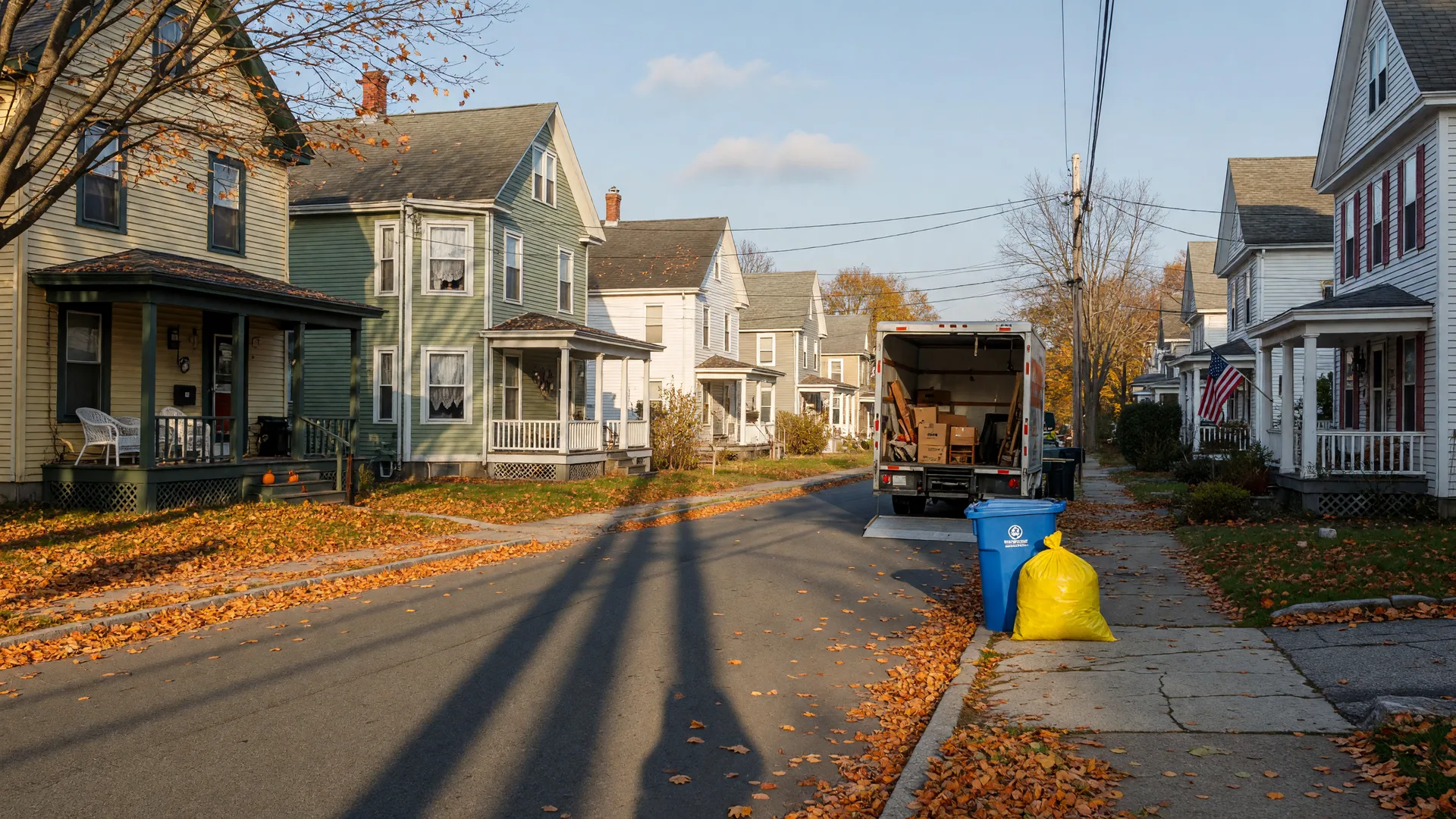
“What do I actually have to set up when we move into a house in Worcester?” is a question I hear from nearly every relocating buyer, and it deserves a concrete answer, not a shrug. Unlike some cities where trash, water, and parking are spread across private haulers and contractors, Worcester runs most of these services through its own departments. Here is the practical, dated guide to the services that matter in your first weeks as a Worcester homeowner.
Trash & Recycling: Weekly Curbside, Official Yellow Bags
The City of Worcester provides weekly curbside trash and recycling collection for residential buildings with one to six units. Buildings with seven or more units must arrange their own private hauler, which is a detail worth confirming if you are buying a small multi-family property. For single-family homes and most small buildings, the setup is simple: recycling is free, and trash goes in official yellow Pay-As-You-Throw (PAYT) bags sold at local retailers, the Worcester 311 Customer Service Center, and vending machines around the city.
Your pickup day depends on your address, and you can look it up on the city’s trash and recycling schedule map at worcesterma.gov/trash-recycling/schedule. Bags and bins go to the curb on your scheduled collection day, with the city asking residents to set them out in the early morning; the schedule page gives the exact window. When a collection day falls on a holiday, pickup shifts back one day for the rest of that week. Bulk items like furniture and appliances are not collected curbside; they are taken to the Residential Drop-Off Center at 1065 Millbury Street instead.
If you are buying a building with seven or more units, budget for a private waste contract. The city does not provide curbside trash service to buildings above that size, and the hauling cost is part of your operating expense as a landlord. Ask the seller for the current contract and its expiration date before you close, so you know exactly what you are inheriting.
Water & Sewer: One Quarterly Bill from the City
Water and sewer are billed together by the City of Worcester’s Department of Public Works Water Division, and most residential meters are billed quarterly, about every three months. For fiscal year 2027, which began July 1, 2026, the city’s current rate is $3.85 per 100 cubic feet for water (unchanged from the prior year) and $10.22 per 100 cubic feet for sewer after the increase approved in spring 2026. You can pay online through the city’s payment partners at worcesterma.gov/online-payments, and paper bills are still mailed. For billing or service questions, call 508-929-1300 or email dpw@worcesterma.gov.
Because water and sewer bills follow the property, not the meter reader, the utility setup for a buyer is mostly about making sure the account is transferred into your name at closing and that the billing address and contact information are current. Ask your attorney or closing agent to confirm the final water and sewer reading at the closing table, so you are not paying for the seller’s prior usage.
Electricity & Gas: National Grid and Eversource
Electricity in Worcester is delivered by National Grid, and natural gas is delivered by Eversource across most of the city, though availability depends on your address. Plan to transfer both accounts one to two weeks before your move-in date so the service is live when you arrive. A practical note for buyers: confirm with the seller which heating fuel the home actually uses, gas, oil, or electric, because that choice drives both your winter bills and your options down the road. If the home has an oil tank, you will also want to verify its age and condition during your home inspection.
Do not forget the non-utility details that come with a move into a new city: you have 30 days to update your driver’s license and vehicle registration with the Massachusetts RMV once you establish residency. The City of Worcester keeps a Resident Guide at worcesterma.gov/resident-guide with phone numbers and moving-in details for everything from voter registration to dog licenses.
Getting Around: WRTA Buses Are Fare-Free
One of the best-kept secrets for new Worcester residents is that the Worcester Regional Transit Authority (WRTA) runs entirely fare-free on all fixed-route and ADA paratransit service. The fare suspension, in place since March 2020, has been extended through June 30, 2027, making it one of the longest-running fare-free transit programs in the United States. You simply walk on and ride.
- Fares: none on any bus, fixed-route or paratransit, through June 30, 2027. If fares ever resume, the published rate card is $1.75 cash with reduced fares for seniors, youth, and children.
- Routes: 26 fixed routes in a hub-and-spoke network centered on the WRTA Central Hub in downtown Worcester, reaching Auburn, Shrewsbury, West Boylston, Leicester, Millbury, Oxford, Spencer, Webster, and more.
- Tracking: real-time bus tracking is available on the WRTA Bus Tracker or the Transit app, so you can see your bus coming instead of guessing.
Source: WRTA, official fares and routes pages, accessed October 22, 2026.
For Boston commuters, the WRTA pairs with the MBTA commuter rail from Worcester Union Station, which runs about 1 hour 35 to 40 minutes to South Station on an all-stops train as of fall 2026. My Worcester-to-Boston commute guide has the full train and drive breakdown for anyone planning to work in Boston.
Street Parking: Only Needed on Restricted Streets
Most Worcester homeowners park on their own property and never think about a parking permit. The Residential Parking Program only applies if you park on a street posted “Resident Parking Only,” which is most common in dense downtown-adjacent neighborhoods. A residential parking sticker costs $10 per vehicle, and you apply through the Residential Parking Permit Application with the Parking Administration Office in Room 203 of City Hall. Before a permit is issued, all outstanding parking fines and excise taxes for every vehicle in the household must be paid in full, and the sticker is mailed to your home address.
If you are buying in a neighborhood with restricted parking, ask the seller (or the agent who knows the block) whether the street is posted, how many permits the household has, and where the nearest off-street options are. It is a small detail that makes a real difference on snow days.
Property Taxes: Set Locally, Watch the Escrow
Property taxes are collected by the city rather than by any utility, and in Worcester they are typically paid through your mortgage escrow account, with the lender remitting them to the city on your behalf. For fiscal year 2027, the City Council approved a residential rate of $12.87 per $1,000 of assessed value on November 24, 2026, down from $13.28 in fiscal year 2026, with the average single-family bill around $5,508, up about $62 as assessments rose faster than the rate fell. Because the rate and the assessment both change, the tax bill you see at closing is not the bill you will pay forever. My property tax guide for Worcester buyers walks through how the rate works, what exemptions exist, and what to ask before you buy.
Your First 30 Days as a Worcester Homeowner
Here is the move-in checklist I hand to relocating buyers, in the order that matters:
- Before closing: transfer water and sewer into your name, confirm the final meter reading at the closing table, and check which heating fuel the home uses.
- One to two weeks before move-in: transfer electricity with National Grid and gas with Eversource (where applicable) so the service is live on day one.
- After you move: look up your trash and recycling day on the schedule map, buy a few sleeves of official yellow PAYT bags, and set your bins out on the right morning.
- Within 30 days: update your license and vehicle registration with the MA RMV, register to vote if you wish, and check the city’s Resident Guide for anything specific to your street, like a resident parking restriction.
[JULIA LOCAL INSIGHT] The question buyers almost never ask, but should, is about the utility history of the specific house, not the city average. Before you make an offer, ask the seller for the last 12 months of electric, gas, and water bills, and ask your lender to run the property tax figure off the actual assessed value. In this market I have seen assessed values and sale prices diverge in both directions, and the difference can be hundreds of dollars a month. It is one of the first things I review with buyers before we ever set a budget. [ORIGINAL IMAGE NEEDED: a photo of a new owner picking up their trash and recycling totes, or a shot of the Worcester skyline from a home’s front steps, would make this guide feel more like Julia’s own; she can supply an original.]
Rates, schedules, and policies above are as of October 22, 2026, and they change. Confirm the details on worcesterma.gov before your move, and if you are house-hunting in Worcester County or Middlesex County, I am happy to walk you through the neighborhood-level details that never make it into a rate sheet, from the feel of a street to the timing of its morning collection.

- City of Worcester: Trash & Recycling and Trash Disposal pages (PAYT bag prices, accessed October 22, 2026)
- City of Worcester: Water & Sewer Operations page (FY2027 rates effective July 1, 2026)
- City of Worcester: Online Payments and Resident Guide pages
- City of Worcester: Residential Parking Program (permit fee and application)
- WRTA: Fares and Routes & Schedules pages (fare-free through June 30, 2027)
- Massachusetts RMV: change of address and license requirements
Figures verified October 22, 2026, and subject to change. Always confirm current rates and schedules on worcesterma.gov.